
Frozen Shoulder Treatment Dubai: Restore Movement & End Pain
Progressive shoulder stiffness making it impossible to reach behind your back, severe night pain disrupting sleep, and loss of simple daily activities like brushing hair or getting dressed—these are the frustrating hallmarks of frozen shoulder, medically termed adhesive capsulitis. This condition causes the shoulder joint capsule to thicken and contract, creating profound stiffness and pain that typically progresses through three distinct frozen shoulder stages over 12-24 months. Dr. Usama Saleh, Dubai’s fellowship trained shoulder specialist with 23+ years of experience, provides expert frozen shoulder treatment focused on accelerating recovery through targeted physical therapy, frozen shoulder exercises, corticosteroid injections, and gentle manipulation.
Understanding Frozen Shoulder
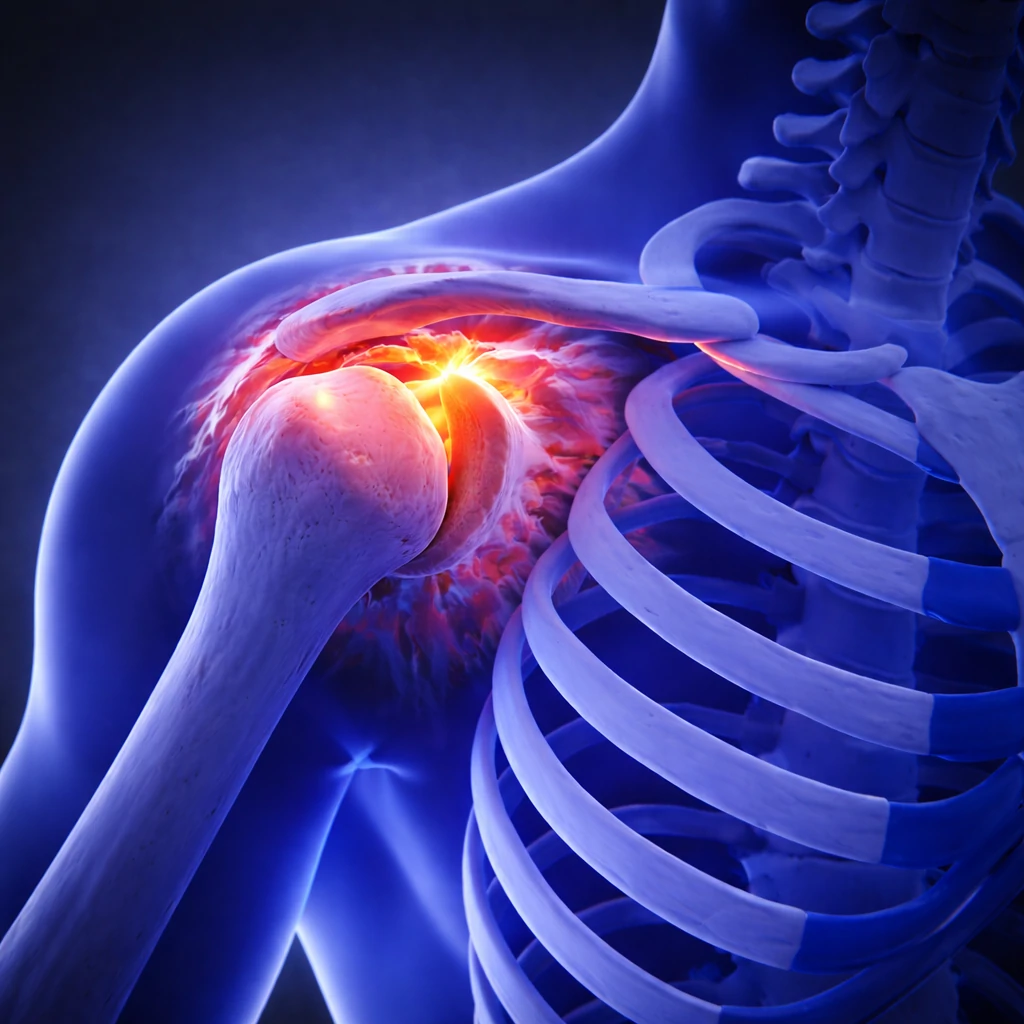
Frozen shoulder (adhesive capsulitis) is a condition where the shoulder joint capsule, the connective tissue envelope surrounding the jointbecomes inflamed, thickened, and contracted. This capsular tightening severely restricts both active mov ement (you moving your arm) and passive movement (someone else moving your arm). Unlike most shoulder conditions where passive motion remains normal, frozen shoulder uniquely limits motion in all directions with a characteristic ‘hard stop’ when trying to move the arm.
The condition progresses through 3 stages of frozen shoulder: Stage 1 (Freezing/Painful): Gradual onset of severe pain worsening over 2-9 months. Progressive loss of range of motion. Pain worst at night. Stage 2 (Frozen/Adhesive): Pain gradually decreases but profound stiffness persists. Shoulder is ‘frozen’ with severely limited movement in all directions. Duration: 4-12 months. Stage 3 (Thawing/Recovery): Gradual spontaneous improvement in motion. Pain minimal. Can take 6-24 months. Total duration untreated: typically 18-24 months, though some cases persist longer.
Frozen Shoulder Symptoms
Recognizing your symptoms helps guide the right diagnosis and treatment. Shoulder instability presents differently depending on type and severity:
Stage 1: Freezing (Painful Phase)
Progressive pain worsening over weeks to months · Frozen shoulder pain most severe at night disrupting sleep · Gradual loss of range of motion in all directions · Difficulty reaching overhead or behind back · Pain with movement and at rest · Duration: 2-9 months
Stage 2: Frozen (Adhesive Phase)
Pain decreases significantly but profound shoulder stiffness remains · Severely limited ROM in all directions (external rotation most affected) · ‘Hard stop’ when trying to move shoulder · Functional limitation can’t brush hair, reach back pocket, fasten bra ·
Stage 3 (Thawing/Recovery)
Gradual spontaneous improvement in motion. Pain minimal. ROM slowly improves. Can take 6-24 months. Total frozen shoulder healing time untreated: 18-24 months typically, though 10-15% have permanent residual stiffness. Treatment accelerates this recovery significantly.
What Causes Frozen Shoulder?
Idiopathic cases: 30-40% occur spontaneously without identifiable trigger. Age 40-60 peak incidence. Slightly more common in females. More common in non-dominant arm (less used). Bilateral involvement occurs in 10-20% eventually.
Diabetes Connection
Frozen shoulder and diabetes strongly linked. 20-30% of diabetics develop adhesive capsulitis vs 2-5% general population. Both Type 1 and Type 2. Diabetic frozen shoulder typically more severe and prolonged. Proposed mechanism: glycosylation of capsular collagen causing stiffness.

Years of Experience
Diagnosis Of Frozen Shoulder
Clinical Examination
Range of motion testing: Severe restriction in all directions forward flexion, abduction, external rotation (most limited), internal rotation. Passive and active ROM both limited (key differentiator). ‘Capsular pattern’: External rotation > abduction > internal rotation restriction. Smooth ‘hard stop’ at end range. No crepitus or grinding. Frozen shoulder diagnosis primarily clinical based on characteristic ROM pattern.
Imaging Studies
X-rays: Usually normal, rules out arthritis or calcific tendinitis. MRI: Can show thickened joint capsule, decreased joint volume, but typically not needed for diagnosis. Ultrasound: May show coracohumeral ligament thickening. Most cases diagnosed clinically without imaging. Imaging mainly to rule out other pathology (arthritis, rotator cuff tear) if diagnosis unclear.
MD, PhD, MRCS (UK), Fellowship-Trained (Canada)
Global Expertise.
Local Heart
Board certified in orthopedics surgery
Frozen Shoulder Treatment Options
How to treat frozen shoulder focuses on reducing pain, maintaining range of motion, and accelerating the natural recovery process. Treatment varies by stage. Adhesive capsulitis treatment is primarily conservative surgery rarely needed.
Stage 1 (Freezing) Treatment
Pain control: NSAIDs, corticosteroid injection (very effective for pain, may slow progression). Gentle ROM exercises avoiding painful range. Physical therapy focusing on maintaining mobility. Sleep positioning to reduce night pain. Goal: minimize pain, prevent excessive stiffness. Best treatment for frozen shoulder in painful phase focuses on pain relief.
Stage 2-3 (Frozen/Thawing) Treatment
Aggressive frozen shoulder physical therapy with capsular stretching. Frozen shoulder exercises daily performed correctly. Corticosteroid injection for residual pain. Hydrodilatation (saline injection to stretch capsule). Manipulation under anesthesia if no progress after 6 months. Arthroscopic capsular release rarely (refractory cases). Goal: restore ROM, accelerate thawing.
Frozen Shoulder Exercises & Physical Therapy
Frozen shoulder exercises are the cornerstone of treatment. Exercises for frozen shoulder must be performed consistently daily stretching essential. Frozen shoulder stretches should take shoulder to point of discomfort but not sharp pain. Frozen shoulder physical therapy provides structured progression and ensures correct technique.
When Is Surgery Needed For Frozen Shoulder?
Surgery rarely needed for frozen shoulder 90-95% improve with conservative treatment. Frozen shoulder surgery considered only when: No improvement after 6-12 months aggressive conservative treatment (PT, injections, home exercises), Severe functional limitation affecting work/daily life, Patient preference to accelerate recovery.
Manipulation Under Anesthesia (MUA)
Most common surgical approach. Under general anesthesia, surgeon manually manipulates shoulder through full ROM breaking up adhesions. Forceful controlled movement restores motion immediately. Followed by aggressive PT to maintain gains. Success rate 80-90%. Risks: fracture (rare <1%), rotator cuff tear, nerve injury. Recovery: immediate motion improvement, 3-6 months full recovery.
Arthroscopic Capsular Release
Less commonly used. Arthroscopic technique cutting thickened capsule and releasing adhesions. More controlled than manipulation. Lower fracture risk. Allows visualization of joint. Combined with MUA often. Recovery: 3-6 months. Reserved for refractory cases or when MUA contraindicated (osteoporosis).
Frozen Shoulder Recovery Time & Healing
How long does frozen shoulder last? Natural history without treatment: 18-24 months typically. With proper frozen shoulder treatment: 6-12 months to 80-90% recovery. Frozen shoulder recovery time accelerated significantly by: Consistent daily exercises, Weekly physical therapy, Corticosteroid injections (especially in Stage 1), Early treatment initiation. Adhesive capsulitis recovery depends on stage, diabetes status, and treatment compliance.
|
Stage
|
Untreated Duration
|
With Treatment Duration
|
|---|---|---|
|
Stage 1 (Freezing)
|
2-9 months
|
Can be shortened to 1-4 months with injections + PT
|
|
Stage 2 (Frozen)
|
4-12 months
|
Can improve to 3-6 months with aggressive stretching
|
|
Stage 3 (Thawing)
|
6-24 months
|
Can accelerate to 3-9 months with consistent exercises
|
|
Total recovery
|
18-24 months typically
|
6-12 months to 80-90% recovery with treatment
|
|
Return to activities
|
18-24 months
|
9-12 months most activities, 12-18 months full
|
Why Choose Dr. Usama
For Frozen Shoulder Treatment In Dubai
Best Shoulder Doctor Dubai — Fellowship-Trained
23+ Years as Dubai's Shoulder Specialist Doctor
Expert in How to Treat Rotator Cuff Tear — All Options
Honest — Surgery Only When Truly Needed
Frequently asked questions
Need something cleared up? Here are our most frequently asked questions.
How long does frozen shoulder last depends on treatment. Natural history untreated: 18-24 months typically (some cases 2-3 years). With proper frozen shoulder treatment: 6-12 months to 80-90% recovery. Frozen shoulder recovery time accelerated by: consistent daily exercises, weekly physical therapy, corticosteroid injections, early treatment. Diabetic frozen shoulder typically lasts longer 18-24 months even with treatment. About 10-15% have mild permanent residual stiffness. Frozen shoulder healing time shortened significantly when treatment started early in Stage 1 (freezing phase).
Best exercises for frozen shoulder: (1) External rotation stretch most critical as most restricted motion. Doorway stretch or stick assisted. Hold 30-60 seconds, 3 sets 3x daily. (2) Wall walks progressive forward flexion stretch. Mark progress weekly. (3) Pendulum exercises gentle gravity assisted motion. Safe for all stages. (4) Overhead pulley use good arm to assist affected arm. (5) Cross body stretch for posterior capsule. Frozen shoulder stretches must be performed daily consistently missing days significantly delays recovery. Frozen shoulder exercises should take shoulder to discomfort (not sharp pain). Work with physical therapist for proper technique. Adhesive capsulitis exercises require months of consistent performance for best results.
Yes, frozen shoulder treatment at home or with medical care, the natural history is eventual resolution in most cases. Untreated frozen shoulder typically lasts 18-24 months before spontaneous improvement. However, 10-15% have permanent residual stiffness without treatment. Benefits of treatment vs untreated: Faster recovery (6-12 months vs 18-24 months), Less severe stiffness at peak, Better final outcome (less residual restriction), Reduced pain during freezing stage, Maintained function during recovery. How to treat frozen shoulder conservatively accelerates recovery significantly daily stretching, physical therapy, injections can reduce duration by 50-60%. Best treatment for frozen shoulder starts early in Stage 1 to minimize progression.
What causes frozen shoulder remains incompletely understood, but known risk factors and triggers: Diabetes (20-30% of diabetics vs 2-5% general population)—strongest risk factor. Frozen shoulder and diabetes strongly linked, likely due to glycosylation of capsular collagen. Shoulder injury or surgery requiring immobilization. Rotator cuff tear or repair. Stroke causing hemiplegia and disuse. Systemic conditions: thyroid disorders, Parkinson's, cardiovascular disease. Prolonged shoulder immobility from any cause. Age 40-60 (peak incidence). Female gender slightly higher. Idiopathic (30-40% occur spontaneously without identifiable trigger). Frozen shoulder causes involve inflammatory cascade leading to capsular thickening and contraction.
Key differences: Range of motion frozen shoulder has severely restricted passive ROM (someone else can't move your arm), shoulder impingement has good passive ROM (only active motion limited by pain). Pattern frozen shoulder restricted in ALL directions (external rotation most), impingement has painful arc between 60-120 degrees. Stiffness, frozen shoulder has profound 'hard stop' stiffness, impingement has pain limited motion. Onset frozen shoulder gradual progression through 3 stages over months, impingement often related to specific overhead activity. Treatment frozen shoulder focuses on stretching and exercises, impingement focuses on rotator cuff strengthening and postural correction. However, they can coexist chronic untreated impingement can lead to disuse and secondary frozen shoulder.
Related Conditions & Procedures
Related Conditions
Shoulder Impingement Relief [link] · Rotator Cuff Tear Treatment · Shoulder Instability Treatment · Shoulder Treatment Dubai hub
Related Procedures
Manipulation Under Anesthesia [mention only if separate page] · Arthroscopic Capsular Release [mention only] · Shoulder Arthroscopy [link]
Take control of your health, mobility, and quality of life.
Your First Step Toward a Stronger Tomorrow Starts Now:
Book your personal consultation with Dr. Usama Saleh today and begin your journey to a better you.
Thank you — your message was sent.
